work
Behind the Glass Wall, Part I
How an Owner Mindset Turns Friction Into Purpose
12 min
read
Summary
The Alignment Gap between employees and owners causes friction. Workers frequently perceive leadership decisions as hostile or opaque because of an asymmetry of risk, where owners carry the burden of survival and financial liability, and workers carry the burden of execution. To overcome this disconnect, you can adopt an owner mindset, assuming responsibility for problems that have no home, finding greater personal purpose and influence within your career.

Kintsugi artisan repairs a shattered bowl. Image generated by Gemini.
Article Voiceover
AI Reaction Audio
Morrissey’s “Shoplifters of the World Unite” is often read as a manifesto for the disenfranchised; a metaphorical call for marginalized and rebellious youth to unite against the established social order. It might have been intended as a play on the Marxist slogan “Workers of the world, unite!”, recontextualized to empower disillusioned youth.
Shoplifters of the World Unite, The Smiths, 1987
It includes a dark lyric in the second verse that hits close to home for anyone who has ever worked under a CEO: “But last night the plans for a future war was all I saw on channel four.” For the employee, looking in from the outside, the owner’s strategy can feel like those secret war plans—nefarious, opaque, threatening, and completely outside of their sphere of control, prompting the need for employees to “unite and take over.“ You see a cost-cutting measure or a sudden pivot and assume that you’re the target. You suspect they’re “up to no good,” and that the war may be against you, or at least that you will be an unwitting casualty.
In reality, the war is usually against bankruptcy, a market shift, or a competitor with deeper pockets and better execution. The friction isn’t necessarily born of malice; it’s born of an asymmetry of information and, more importantly, an asymmetry of risk. This is the Alignment Gap.
I’ve stood on both sides of this divide—five years as an employee, two decades as an owner/operator, followed by another three years as an employee. Sometimes the disconnect is a failure of communication, but more often than not it is a fundamental difference in what each side stands to lose.
I see you rolling your eyes and busting out your tiny violins, but this series isn’t a plea for owner pity, nor is it a defense of bad management. It’s intended as a public service announcement for employees: to help them understand why some decisions are made, and to potentially reinterpret owner behaviour in this context.
In this article, we discuss the origins of the Alignment Gap, what owners are really looking for in employees, and how to narrow the gap between you and your company’s owner(s) by adopting an owner mindset. The central, clarifying question we must all answer is “what would I do if I was in control?”
Communication breakdown
Communicating at a useful level of fidelity rarely happens on the first try. In addition to the fact that our words are not perfect vessels, they carry the weight of cultural context, emotional bias, and both the speaker’s and listener’s projections.
“What I said,” “what I think I said,” “what you heard,” “what you think you heard,” and “what we made it mean” can all be different. And sometimes we just aren’t listening to each other with our full attention. Our self-centeredness may prevent us from practicing empathy. Thankfully, the more our own folly is exposed in public, the more familiar we become with our own communication inadequacies over time.
Communication problems are exacerbated when “owner-speak” and “worker-speak” collide. It can seem like we’re just talking past each other. Owners speak the language of “opportunity, revenue, and survival,” whereas workers use “task, schedule, and delivery.” We thus experience urgency and risk differently: owner urgency is driven by sales timing, legal liability, and cash flow, where employee urgency is driven by client dissatisfaction, product deadlines and quality control. All are real, but they rarely align temporally or structurally across the delivery/management divide.
Hierarchy can also introduce problems. Org charts should exist primarily as tools for managing communications—filtering information so people aren’t drowning in demands they can’t meaningfully address. But an org chart also signals with Orwellian precision which thoughts and opinions count as “more equal than others.” It may feel frustrating that decision-making authority resides solely with owners; employees may question, but owners dictate.

Work hierarchies imply unintended messages. Image generated by Gemini.
This asymmetry can suppress ideas, as employees wrestle with the prospect of applying heart and soul to efforts over which they ultimately lack authority. But it also does something much more diabolical: it absolves employees from the responsibility of fixing the very problems they highlight. The hierarchy effectively licenses cynicism, creating a safe space that protects employees from the consequences of their own observations.
You’re thinking “but I don’t see ‘solving company problems’ in my job description. Is this really up to me?”
Seeds of action
Early in a career, it is rational to externalize difficult problems. You lack the mandate, the resources, and perhaps the judgement to solve them alone. The shift from “performing assigned tasks” to “identifying and owning unsolved problems” can be very uncomfortable, and some never make it. We’ve all heard the protest “that’s way above my pay grade,” excusing the would-be participant from further effort and toil. This is ironic because owning the solution would rapidly improve their pay grade.
It isn’t necessary to cross this chasm if that’s simply not how you want to work. But while this may be perfectly optimal for you, it pays to be honest with yourself about the implications of that choice. Three important things happen by remaining purely in an order-taking, “delivery” mindset:
your compensation won’t rise as fast as it could have
you can’t complain as much about “the way things are” because you’ve decided to be more passive in your response to problems
you lose the potential satisfaction of driving your team toward a better world, the personal value of which is vast; this is a matter of using work as vehicle for self-expression and a source of meaning and purpose
In my career, I’ve found that I could easily accept the first thing, within reason. Though venting can be comforting, doing so without helping to find a solution eventually feels fraudulent. Who wants to be known as a complaining non-participant? Living with the third thing over the long term would tear my psyche apart. I accept that different people are different. And I don’t expect that I will always enjoy my work. But—call me unreasonable—I do need for my work to be personally meaningful in some regard. You might find your purpose elsewhere, but I can’t abide by the idea of spending eight hours of each of my life’s days in self-suppression mode.
It may seem harder to originate change from the bottom because you can’t exactly act with unfettered freedom. Also, some of the context required for optimal decisions resides at the top, where strategic thinking, business constraints, and risks continually migrate. It may be initially difficult for you to holistically survey the problem space.
This does not mean that you don’t have the opportunity to share constructive input, defend your opinions, and influence the ship’s heading. Owners are often insulated from the situation “on the ground,” and they know it. It’s usually impractical for them to directly and continuously poll everyone in the company for ideas related to a proposed direction. “Bottom up” communication is usually more timely, practical, and embedded with intelligence rooted in the realities of delivery. The juicy new ideas usually originate from the places where the negative effects of the status quo are most keenly felt.
This should go without saying, but there’s absolutely no reason for owners or senior management to be the only ones fielding ideas for improving the company. A good leader will defer to whomever can recognize and help solve problems.
So in the normal course of business, we notice problems. We use different languages to describe them. We misunderstand each others’ intent. We assume we don’t have the mandate to speak up. We fail to trust that our voices will be heard and valued. And so we end up doing little to make changes for the better. What’s missing here? The answer is simpler than you might think.
The economics of worry
When a person (owner or worker) in the organization seems “thick-headed,” they aren’t necessarily ignoring your idea; they may be calculating the cost of failure in a way that you might not yet see. They’re wary of spelunking through unknown caverns riddled with uncertainty, cost, and risk, especially if the proponent’s ideas seem to ignore important realities and constraints, or haven’t been fully mapped to their potential consequences. This kind of thinking is evolutionary: it keeps us safe from the prowling lion just outside the encampment.
Employees sometimes miss the fact that the better decisions, solutions, and processes they might propose also positively affect the owner’s bottom line. As such, any clear-thinking owner wants to integrate valuable feedback if there’s a chance it would improve the business. You could say that some leaders find it hard to “get out of their own way,” but most would make the required changes if they recognized the opportunity. The question is... will you help them?
Everyone wants “change for the better,” but ideas and opinions are cheap relative to execution. And though we can’t fully predict what will work, we all know that it will likely be hard, and that some group of people will have to worry about it. This is your trump card as a person with an idea: you can, with impunity, appoint yourself the CWO (Chief Worrying Officer) for that idea.

Appoint yourself the Chief Worrying Officer. Image generated by Gemini.
Whenever considering a new idea, ask yourself:
Who is going to manage this thing now and in the future?
What does that mean for their day-to-day?
Is it reasonable to expect them to make the necessary changes to support the idea?
Does the idea have enough value to warrant this cost?
Owners hate having to worry alone. I suspect I may even resent it a little, even though you might say I invited this complexity upon myself. Complete authority over strategy and execution can feel lonely, isolating, and even scary. My “wrong moves” occur in full view, and can negatively affect the lives of my people.
Offloading worry has real value to me, and believe it or not, I will compensate you for relieving me of it, because it creates a better risk/reward balance for me. The burden of negotiating the path to reward is shared. I’m looking for people who have good ideas and are willing to stay the course to implement them.
The most valuable employees aren’t those who wait for direction; they identify the gaps—the “orphaned” problems that no one has claimed—and step in to shoulder them. You don’t need to be an owner to adopt this mindset, but if you do become an owner, it’s automatic; you have no choice. Ultimately, the economics of worry means that you get paid not for what you know, but for what you’re willing to carry.
The owner mindset
Let’s say you’re ready to give this a shot. How to proceed?
Your job is to provide decision-makers with rational arguments that make sense in the context of business. Sharpen your rhetoric. Bring your most persuasive propositions. But explore the overall context first. It’s always a good idea to ask questions at the outset to understand why the decision maker initially optimized one way or another, before offering a counterproposal. You’ll then have a better chance of shaping your solution and further helping with that optimization.
I remember participating in extended office environment design sessions to address complaints of noise from constant foot traffic over our wood floors. This led us to engage in a consultation with a professional interior designer, and finally to purchase and install industrial carpeting along the well-travelled walkways. We also hung sound dampening acoustic boards for increased privacy and quiet. The project incurred significant time and expense, but it was a definite upgrade to the office design, which was much less noisy, as hoped.
Just before the installation, an employee tossed out a thought that “carpets shouldn’t be installed because they trap unwanted dust.” Ignoring the fact that the carpets were to be cleaned twice a week, making this a non-issue, it was disheartening that he didn’t acknowledge the noise problems we’d fought so hard to solve, the thousands spent fixing them, or the fact that we were doing this solely for the benefit of our people. I thought to myself “why do we even bother trying to help?”
Barging in with complaints and peppering the decision maker with uninformed opinions makes it easier for them to dismiss you. If you arrive with questions, and considered and reasonable suggestions for improvement that consider the fuller problem space, they are much harder to ignore; doing so would seem idiotic.
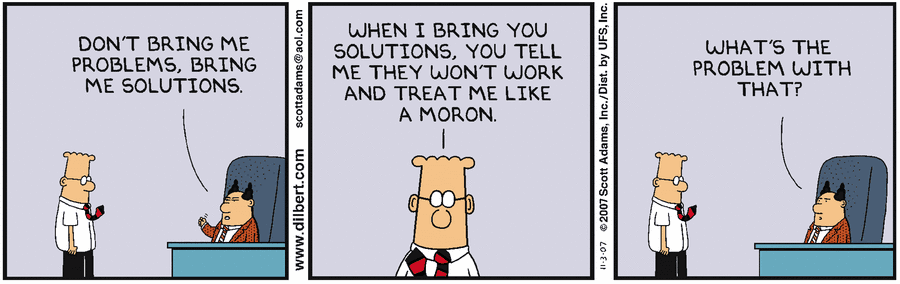
©Scott Adams, Dilbert Text Archive, Friday, November 2, 2007
You’ll still have to locate the right audience and practice your rhetorical framing, but after a while you should start to see some movement. The takeaway here is to more fully inhabit the owner mindset. Owners will listen to you as long as:
you’re willing to listen to criticisms of your proposed approach
you don’t abandon the idea the moment things get difficult
you’re committed to developing and rallying a tribe, aligning minds in your organization one at a time
you help people navigate the inevitable growing pains of adoption
you remain flexible and patient over the long haul
you’re willing to risk your relationship capital and reputation even when facing detractors
you speak the language of risk and reward, proposing metrics and targets to measure progress and success
If the owner green-lights the initiative, they will of course try to help you where they can.
Practice translating your thoughts into a language your counterpart can understand (and filter their words through that translator in reverse), to narrow the Alignment Gap.
Jot down a short business case for each of your ideas, which means thinking about the cost of each idea, as well as its potential benefits, over the short and long term.
Ask yourself if you would risk your own money on this bet. It’s easy to play poker with someone else’s stack. The benefits don’t always have to be immediate cash; there is often hidden value to be found in intangibles like “employee satisfaction” and “worker retention.” Once these have been identified, though, come up with a rough financial model that assigns costs and values to make it easier to calculate ROI. This need not be exact; just directional.
Enhance your credibility by having skin in the game: time, energy, and reputation. If you’re feeling plucky, propose a value-sharing bonus to tie a reward to your outcome, or stake part of your bonus on the success of the attempt.
Making your mark
In a 1994 interview with the Santa Clara Valley Historical Association, Steve Jobs talked about these idea more broadly, framing them as a general approach to a limitless life. While I did acclimatize to the owner mindset in business over the course of my career, I must admit that I’m still very much a student of applying this thinking to my own life. Nevertheless, his thoughts still ring very true.
When you grow up, you tend to get told that the world is the way it is and your your life is just to live your life inside the world. Try not to bash into the walls too much. Try to have a nice family life, have fun, save a little money. But life that’s a very limited life. Life can be much broader once you discover one simple fact. And that is everything around you that you call life was made up by people that were no smarter than you. And you can change it.
You can influence it. You can build your own things that other people can use. And the minute that you understand that you can poke life and actually something will… you know if you push in something will pop out the other side; that you can change it… you can mold it. That’s maybe the most important thing… is to shake off this erroneous notion that life is there and you’re just going to live in it versus embrace it, change it, improve it, make your mark upon it.
I think that's very important and however you learn that, once you learn it, you'll want to change life and make it better because it's kind of messed up in a lot of ways. Once you learn that, you'll never be the same again.
- Steve Jobs,1994, Santa Clara Valley Historical Association interview
Persistent miscommunication within an organization can fuel discontentment and even paranoia. But good communication is everyone’s responsibility—and you can only control your own. Be a full and enthusiastic proponent for what you care about. At some point you may feel like you are dragging the rest of the company along (including the owners), putting up with non-verbal road-blocking, side-eye doubt, and even a little kicking and screaming along the way. Remember that it can be difficult to even consider the merit of an idea without constructing opposing thoughts, so these won’t be in short supply. Treat resistance not as rejection, but as a stress-test of your proposal.
Owners appreciate people who apply their energies to improving things while sharing their front-line perspectives. You can design a much better solution together than either of you could alone. You are not the disempowered “shoplifter” you might imagine. The Alignment Gap narrows when someone decides to own changes for the better. Choosing to step into the gray area where solutions are proposed, decisions are made, and consequences are shared adds a sense of purpose to your daily work.
Next in this series: Part II — Risking the Truth
———————————————————————————————
Text written and spoken by Jeremy Chan — a human being!
———————————————————————————————
Voiceover Music from #Uppbeat
https://uppbeat.io/t/fourth-dogma/queen-peaks
License code: DMCMYAGWYWQOUHLF
Podcast Music from #Uppbeat
https://uppbeat.io/t/soundroll/time-to-believe
License code: RFWBIW8LHBQ4IKBG
More in
work


work
Jul 24, 2026
Behind the Glass Wall, Part III
The Compensation Equation
Pay is another aspect of the Alignment Gap between employees and owners. This article discusses the employer mindset in compensation, the role of intangibles, the problem with remote work, and the value of the unselfish edge in improving your take-home value. Ultimately, the text encourages a holistic view of employment where shared success is prioritised over rigid extraction.

work
Jul 15, 2026
Behind the Glass Wall, Part II
Risking the Truth
While truth is a fundamental tool for personal growth and organizational trust, sharing too much information can cause unnecessary stress or panic. Leaders must often withhold details to maintain confidentiality or stability. This is the transparency paradox.